AI receptionist for contractors: does it actually work?
AI receptionist for contractors answers calls 24/7, texts back missed calls in 30 seconds, and books jobs while you're on another call. We'll show you if it's worth it.
Updated August 2026 · By JR Grow
What is an AI receptionist for contractors and does it actually work?
An AI receptionist for contractors is software that picks up your phone calls when you can't, captures the caller's name and job details, texts them back in 30 seconds, and logs everything on your dashboard. No human on the other end. No voicemail tag-backs.
Does it work? Yes. Missed-call text-back recovers up to 80% of lost jobs. That matters because 67% of callers won't leave a voicemail. They call the next roofer or electrician instead. An AI receptionist makes sure you're not that next guy.
Real numbers: contractors using a missed-call text-back system see roughly 3.5x more calls after 90 days of optimization. One HVAC owner in Ohio went from losing 7 calls a week to booking 4 of them. That's $12,000 a month of jobs he was already getting calls for.
How does an AI phone system actually answer calls for contractors?
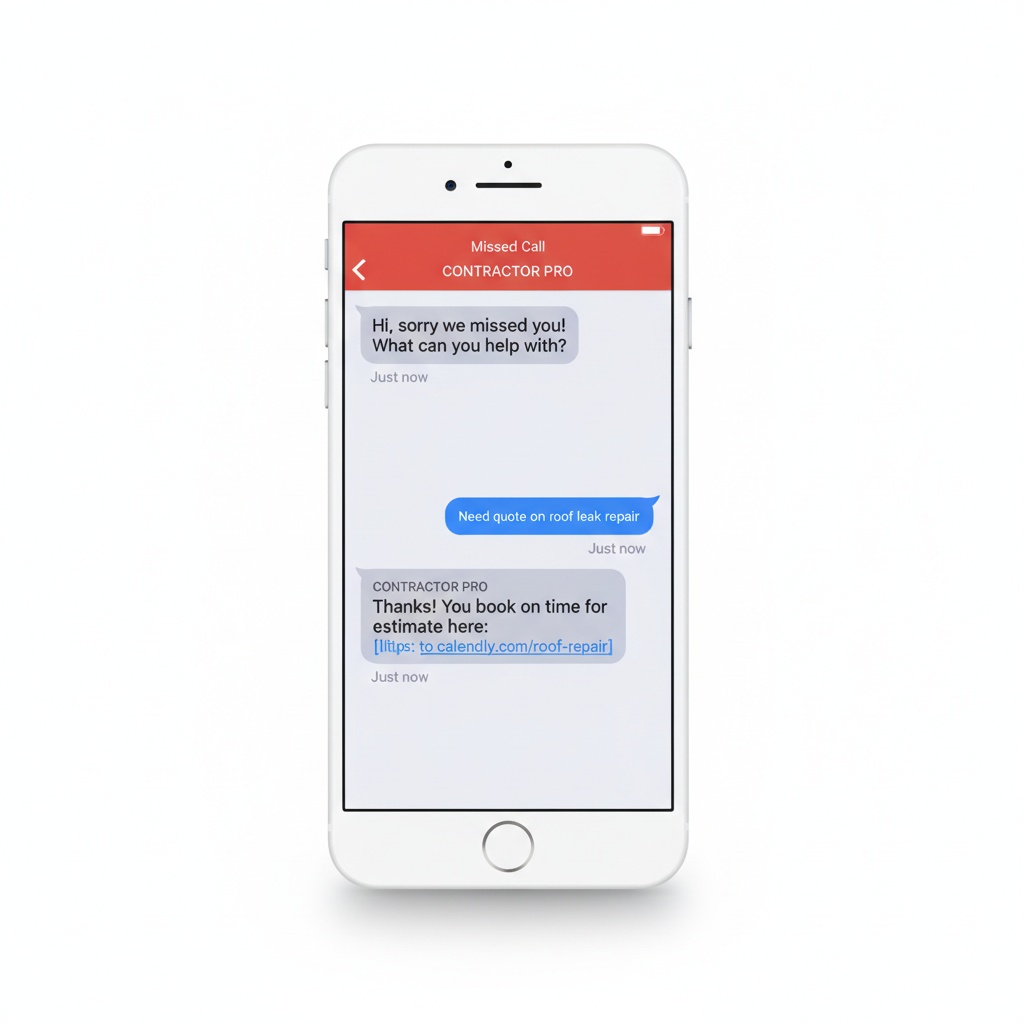
Here's the flow. Your phone rings while you're on a job or talking to another customer. The AI receptionist picks up instantly. It greets the caller with your business name, asks what they need, captures their number, and either (a) schedules them into your calendar if you have availability, or (b) sends an automated text within 30 seconds saying 'Hey, we got your call, we'll be in touch'.
The entire conversation is logged in your dashboard with the caller's info. You see their name, phone number, what job they called about, and the exact time they called. No missed context. No 'someone called but didn't say what they wanted'.
Some AI phone systems let you set rules. Example: 'If they call after 6 PM, text them back immediately. If they call about a roof leak, put them in the urgent queue.' You stay in control. The AI receptionist just handles the grunt work.
AI receptionist for contractors vs. hiring a real receptionist
A real receptionist costs $15 to $18 an hour, 5 days a week, $3,500 to $4,500 a month. That's $42,000 to $54,000 a year. They also need time off, sick days, and sometimes they miss calls or forget details.
An AI receptionist costs $200 to $400 a month, never sleeps, never forgets, and texts back faster than any human ever could. The tradeoff: it can't handle nuance. If a caller says 'I need a roof inspection, but I'm also interested in gutters,' the AI might miss the gutter part. A real receptionist would catch it.
For most contractors doing $500K to $2M a year, an AI receptionist is the move. You get 95% of the upside for 8% of the cost. If you're doing $5M+ and have calls all day, you might need a human, a hybrid, or just a virtual receptionist who works on commission.
When should you add a virtual receptionist to your business?
Add a virtual receptionist or AI phone system when you're losing more than 3 calls a week. How do you know? Ask your team: 'How many times did someone call and we didn't pick up?' Most contractors are shocked by the answer.
You also need it if your phone rings while you're on site closing a job or talking to a customer. That's literally every day for a small contractor. You can't be two places at once. An AI receptionist can.
One more sign: if you're paying for Google Ads or local SEO and getting traffic but losing jobs because the phone rings and nobody picks up, you're flushing money down the drain. Fix the phone first. The best AI receptionist for contractors in 2024 is one that integrates with your website, Google Business Profile, and SMS, so nothing falls through the cracks.
How much does an AI receptionist cost for contractors?
Standalone AI phone or call answering systems run $200 to $500 a month depending on call volume and features. Most contractors use 100 to 300 minutes of call handling per month, which lands you in the $250 to $350 range.
If you layer in a missed-call text-back engine (which is more valuable than the call answering alone), you're looking at $300 to $500 a month for a full setup that includes SMS, logging, and calendar sync.
A done-for-you system that bundles an AI receptionist, missed-call text-back, a fast mobile website, local SEO, and an automated review engine runs one flat rate around $199 to $299 a month. No contract, no setup fees, usually live in 7 to 10 days. That's the bet: instead of juggling 4 vendors and 4 dashboards, you get one system that talks to itself.
What data should an AI receptionist capture from every call?
At minimum, your AI phone system should grab the caller's name, phone number, and what they need. Optional but valuable: their address (so you can check if it's in your service area), their email, and their estimated timeline ('need it this week or next month').
Every call log should be timestamped. You need to know if they called at 8 AM on a Tuesday or 11 PM on a Sunday. That tells you when you're getting most of your volume and when you can staff smarter.
The dashboard should show you a weekly or monthly report: total calls, calls answered by you vs. the AI, missed calls, callbacks that turned into jobs, and average response time. That data is how you improve. If you see 'we're losing 12 calls a week at 5 PM,' you can hire an apprentice to answer phones or add a second line.
When an AI receptionist is NOT worth it (honest caveats)
If you only get 5 to 10 calls a month, an AI phone system doesn't move the needle. The ROI is too low. Same if you work 9-5 with no after-hours calls and you're already answering every phone.
An AI receptionist also won't help if your problem isn't missed calls. If people call but hang up because your website looks like it's from 2004, or they can't find your pricing, that's a different problem. Fix the website first. Then add the AI receptionist.
If you need to handle very complex calls (architectural renderings, detailed insurance conversations, negotiating price on a $50K job), the AI will struggle. It's built for capturing information and routing, not closing deals.
And if you're in a market where customers expect to talk to a human immediately (some high-end luxury services), an AI pickup might feel cheap even if it's actually smarter. Know your customer. Know if they want speed or trust first.
How to pick the right AI phone system for your trade
Start with these non-negotiables: live call recording or transcripts, text-back within 30 seconds, integrations with your calendar and SMS, and a mobile dashboard so you can review calls from the job site.
Second, check the quality of the AI voice. Call the company as a test customer. Does the voice sound natural? Does it understand accents, background noise, and regional slang? Some AI phone systems sound like robots. Others pass as human until the caller realizes there's no emotion.
Third, read reviews from contractors in your trade. A plumber review of an AI receptionist matters more than a dentist review. Plumbers and electricians get very different call types, so the system needs to be tuned for yours.
Finally, pick one that's not tied to a contract. You should be able to cancel in 30 days if it's not working. Most good AI phone vendors offer that. If they push a 12-month contract, keep looking.
Real example: how one roofer recovered 80% of missed calls
A roofing company in North Carolina was getting slammed during spring storm season. Owner's phone rang 30 to 40 times a day. He picked up maybe 60% of them. The other 40% went to voicemail. Of those, roughly 20% called back. The rest called a competitor.
He installed an AI receptionist and missed-call text-back system. Same spring, same volume of calls. Now the system catches the ones he misses, texts the caller in 30 seconds with 'We got your call, we're sending an inspector this week. Reply with your address.' Callers text back their address. His crew gets the lead before the sun sets.
Result after 90 days: 37 more jobs booked. Average job value was $1,200. That's $44,400 in gross revenue from calls he was already getting. The system cost him $300 a month, $900 for the quarter. ROI was 49x in 90 days. Not average, but it shows what's possible when you fix the leak in your bucket first.
Key terms
Missed-call text-back: An automated SMS sent within 30 seconds to a caller who reached your voicemail, giving them a chance to respond without redialing. Recovers up to 80% of lost jobs.
Virtual receptionist: A remote person or AI system that answers calls for your business, takes messages, and schedules appointments. Can be human-based, AI-based, or hybrid.
Call routing: The system that directs an incoming call to the right person, department, or queue. An AI receptionist can route based on call type (emergency, routine, sales, etc.).
Call transcription: A recording of the entire call converted to text so you can review it later without listening to audio. Saves time and creates a searchable log.
Straight from Google, worth reading in full: Tips to improve your local ranking on Google and Guidelines for representing your business on Google.
Want your phone ringing again?
JR Grow builds your website, ranks you on Google, recovers missed calls, and fills your Google profile with 5-star reviews. Done for you. One flat price. Cancel anytime. Live in 7-10 days.
Book a Free Strategy Call →Frequently asked questions
Can an AI receptionist answer technical questions about roofing or HVAC?
Not really. An AI receptionist for contractors is trained to capture basic info and book appointments, not diagnose problems. It can ask 'Is there water coming in?' but it can't assess severity or quote a repair. It's a filter, not a technician. Use it to gather leads, not to close them.
Will an AI phone system cost more if I get a lot of calls?
Most vendors charge based on minutes of call handling, not number of calls. 100 calls at 2 minutes each is 200 minutes. 40 calls at 5 minutes each is also 200 minutes. So a contractor with fewer but longer calls might pay the same as one with more short calls. Check the pricing model before you sign up.
Can I test an AI receptionist before paying for a full month?
Some vendors offer a 7 to 14-day free trial. Use it. Forward your business line to their number, let it answer 20 to 30 real calls, and see if the system captures the right details. Don't just read reviews. Test it live with real callers.
What if the AI receptionist schedules an appointment wrong or double-books me?
Good systems pull your real calendar, not a separate calendar. So the AI sees you're booked Wednesday and doesn't schedule another job then. But mistakes happen. Always review the log before bed. Catch errors before your crew shows up at the wrong address at 7 AM.
Do I need an AI receptionist if I already have Google Business Profile optimization?
Google Business Profile drives traffic and phone calls. An AI receptionist catches the calls you miss. They work together. Google fills your funnel, the AI receptionist makes sure nothing leaks out the bottom. If you're getting more calls than you can answer, yes, get an AI receptionist.