
How to get more Google reviews contractor guide for autopilot
How to get more Google reviews contractor-style means automating review requests after every job, responding to bad reviews within 24 hours, and fixing the gap between great work and proof online. Most contractors miss 80% of review opportunities because they don't ask.
Updated August 2026 · By JR Grow
Why contractors need to know how to get more Google reviews
You finish a $8,000 roof job. Homeowner is thrilled. You pack up and move to the next one. Three weeks later, a potential customer picks your competitor because they have 47 reviews and you have 4. That's the gap.
How to get more Google reviews is not about begging for five stars. It's about building a system that asks every customer at the right moment, captures their response, and turns proof into jobs. Google ranks on three things: Proximity, Relevance, and Prominence. Prominence means reviews, photos, and consistent posting. Miss this, and 88% of local searchers never see you. They see the guy in the top 3.
Contractors who automate review requests see roughly 47 new reviews per year and 3.5x more calls within 90 days. That's not magic. That's a system.
The math behind review requests and why most contractors fail
67% of callers won't leave a voicemail. They'll call the next guy on Google. Same logic applies to reviews. You can't rely on customers to remember, find your Google Business Profile, and type something kind. They won't. Life moves fast.
Most contractors ask zero times. Some ask once, in person, after the invoice is signed. Wrong timing. The customer is tired, thinking about the next thing, not celebrating your work yet. Best moment is 2-3 days after completion, when the work is done, fresh in mind, and satisfaction is still high.
The fix is review automation. A system that sends a text or email asking for a review automatically, no manual work. With the right tool, you ask every customer the same way, every time. Remove the guesswork. That's how to get more Google reviews at scale without burning out yourself or your team.
Step 1: Set up your Google Business Profile for review requests
Before you ask for a single review, make sure your GBP is complete. Upload a real photo of your work (not a logo). Add your service area, hours, and a clear description of what you do. Incomplete profiles rank slower and look like a ghost business.
Make sure your review link is live. It's in the Google Business Profile dashboard under "Customers" then "Reviews." Copy that link. You'll need it.
Test it yourself. Click the link on mobile from a different device. Confirm it opens to the review page, not a 404. If it breaks, nothing you do downstream matters.
How to get more Google reviews using text and email automation
Automated review requests work because they run on a schedule, not on your memory. Here's the workflow:
- Job completed and paid. Automatically send a text 2 days later: "Hi [Name], thanks for choosing us for your [service]. We'd love to hear about your experience. [short review link]"
- No response in 5 days. Send an email with the same link, slightly different copy.
- Track open rates and clicks. Adjust timing and copy based on what works in your market.
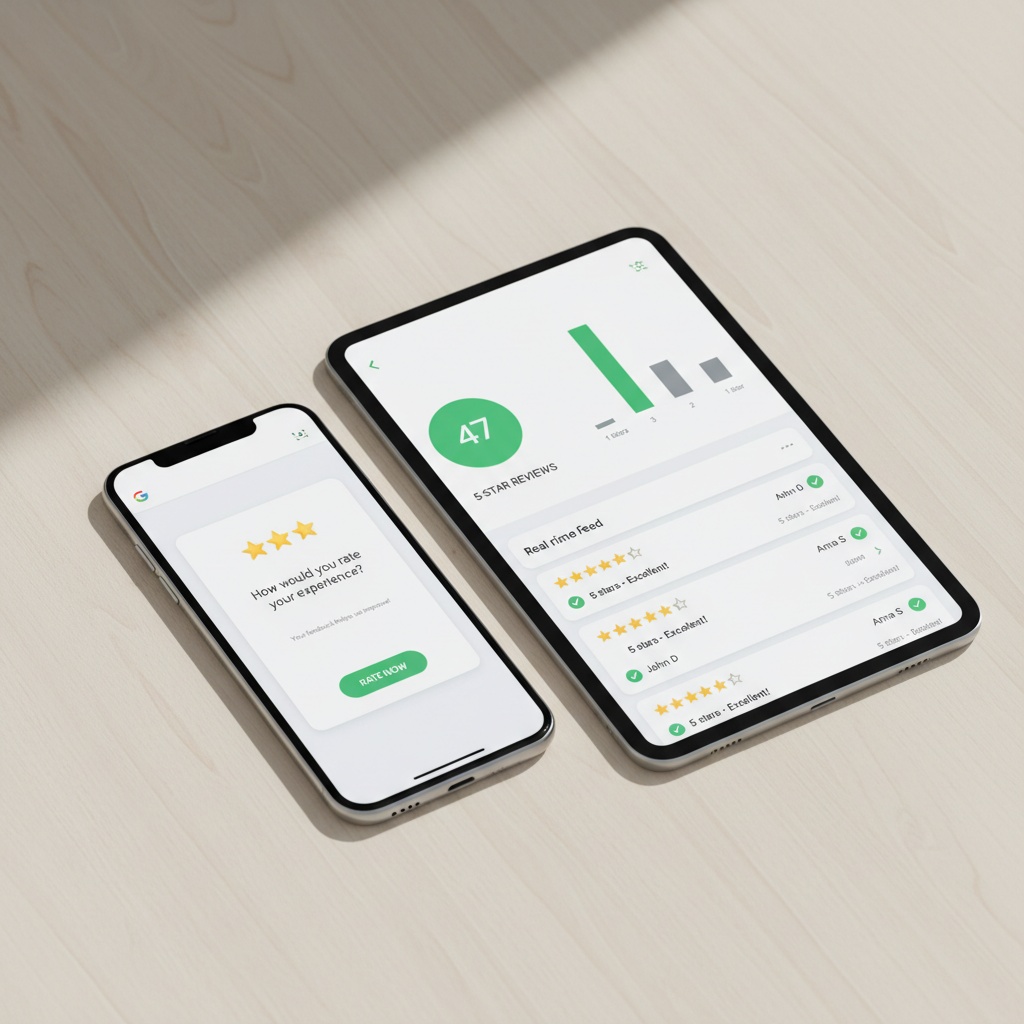
The best part: you don't touch it. Once it's set, it runs every day for every customer. JR Grow, for example, includes a 5-star review engine that handles this on autopilot across all four job engines, so contractors see 47 reviews a year without writing a single message themselves.
For DIY, tools like Birdeye, Podium, or even Google's own Customer Insights program can automate low-volume requests. But most small contractors use a done-for-you system where the software does the entire flow, including capturing and posting responses.
Reputation management: responding to bad reviews fast
You can't control bad reviews. You can control how fast you respond. Respond within 24 hours, every time. That matters to Google and to people reading.
Template for a bad review response: "Hi [Name], we're sorry this didn't meet your expectations. We stand behind our work. Can you call us at [number] so we can make it right?" Short, professional, takes ownership. Shows you care.
Don't argue online. Don't defend yourself in public. Call them. Fix it. Then ask them to update their review if the second experience was better.
A solid reputation management process—check Google alerts for new reviews daily, log them, respond within 24 hours, and follow up—keeps your profile healthy and signals to Google that you're an active, responsive business.
Why automation beats manual review requests every time
Manual reminder: "I need to ask Mr. Johnson for a review." You forget. Or you remember at 8 PM after a 12-hour day. By then, momentum is gone. He's moved on. You get nothing.
Automated review requests fire the same day, same time, to every customer. No exceptions. No relying on you. This is why contractors who use review automation see 3.5x more calls within 90 days and roughly 47 new reviews a year. The system never sleeps. It never forgets.
Compare: a contractor who manually asks 1 in 10 customers (because they remember and feel comfortable doing it) will get maybe 2-5 reviews a year. An automated system asking all 10 will get 7-12. The only difference is a tool running on your behalf.
When review automation alone isn't enough (and what to do)
Automation solves the "asking" problem, not every problem. If you have a history of bad work, no amount of review requests will help. A well-reviewed competitor is the goal. If your real problem is quality, fix that first.
Automation also works best with high job volume. If you do 2 jobs a month, 47 reviews a year is impossible. You need at least 15-20 jobs per month for review automation to move the needle fast. Below that, focus on selective manual outreach and word-of-mouth.
Reviews are also location-dependent. Ranking is different on every street corner. You might be a 4.8-star business on Oak Street and invisible on Maple. Review count alone doesn't fix bad Proximity or Relevance. A complete system addresses all three ranking factors, not just reviews.
Building reputation with photos and posts alongside reviews
Reviews matter. But Google also ranks on Prominence, which includes photos and activity. Upload a before-and-after photo from every major job. Add a post once or twice a month: seasonal tips, a job update, a team photo. It signals that you're a real, active business.
Ask customers for photos too. "Can you send a photo of the finished work?" Most will. Use them in your Google Business Profile and on your website. More proof = more trust = more calls.
A contractor with 30 reviews, 50 photos, and monthly posts ranks better than one with 60 reviews and no activity. Prominence is dynamic. Google wants to see ongoing engagement, not a profile that was set up once and abandoned.
Typical results and why 90 days matters
Don't expect 10 new reviews next week. Expect a system that compounds over time. Here's the realistic timeline:
- Months 1-3: Build review volume from 1-2 per month to 4-6 per month as automation kicks in.
- Months 4-6: Momentum increases. You're now getting 6-8 per month as Google sees more activity and ranks you higher.
- Months 7+: Compounding effect. Higher rank brings more traffic. More traffic, more reviews. You're getting 8-12 per month and 3.5x the calls you had before.
This assumes you're doing the work and the work is good. Automation can't fake that. But if the work is solid and nobody knows about it, automation closes that gap fast.
Key terms
Google Business Profile: A free Google tool that displays your business name, address, hours, and reviews when customers search for your service in a local area.
Prominence: One of three Google ranking factors for local search, based on review count, review freshness, photos, posts, and overall business activity.
Review automation: A system that automatically sends review requests to customers via text or email at scheduled times without manual intervention.
Missed-call text-back: Technology that automatically sends a text to a customer within 30 seconds if they call your business and hang up before you answer, recovering calls that would otherwise be lost.
Straight from Google, worth reading in full: Tips to improve your local ranking on Google and Guidelines for representing your business on Google.
Want your phone ringing again?
JR Grow builds your website, ranks you on Google, recovers missed calls, and fills your Google profile with 5-star reviews. Done for you. One flat price. Cancel anytime. Live in 7-10 days.
Book a Free Strategy Call →Frequently asked questions
How many Google reviews do I need to rank in local search?
There's no magic number. Ranking depends on Proximity, Relevance, and Prominence. A competitor with 20 well-written reviews and consistent posts can outrank someone with 100 old, stale reviews. Focus on steady growth, quality responses, and activity. 30-50 reviews is usually enough to compete in a typical contractor market if the rest of your profile is optimized.
What's the best time to ask a customer for a Google review?
2-3 days after the job is complete. Timing is everything. Too soon (same day), they're tired. Too late (2 weeks), momentum is gone. Automated systems fire at the same time every day, so you don't have to guess. Most contractors see the best response rate between Monday and Thursday at 2-4 PM.
Can I buy Google reviews?
No. Google will catch it, remove the reviews, and penalize your profile. It's not worth it. Fake reviews destroy trust and tank ranking. The only way is earning them the right way, which is why automation matters. Real reviews from real customers, asked at the right time, scale faster than anything else.
How do I respond to a one-star review from a disgruntled customer?
Respond within 24 hours. Stay calm. Apologize for the experience, take ownership, and ask them to call you so you can fix it. Don't argue or defend yourself online. Take the conversation offline, solve the problem if possible, then ask them to update their review. Reputation management is about showing other customers that you care and can fix things.
Does Google favor new reviews over old ones?
Yes and no. Recency matters, but so does volume. A business with 50 reviews from the last 6 months ranks better than one with 100 reviews all from 2 years ago. This is why ongoing review automation beats a one-time push. Steady monthly reviews signal active business to Google. Consistent activity is ranked higher than lumpy activity.