Local SEO for contractors: the beginner-to-ranked playbook
Local SEO for contractors is the system that puts your name in front of homeowners searching for your trade on Google Maps and Google Search right now, in your zip code. It's not optional anymore. 88% of local mobile searches end in the top 3 results. If you're not there, you're invisible.
Updated August 2026 · By JR Grow
What local SEO for contractors actually does
Local SEO for contractors is the process of getting your business to show up when someone within 5, 10, or 25 miles searches 'roofer near me' or 'emergency plumber' or 'HVAC contractor in [your town]' on Google. It's not about becoming famous nationally. It's about owning the map pack and the top 3 organic results on your home turf.
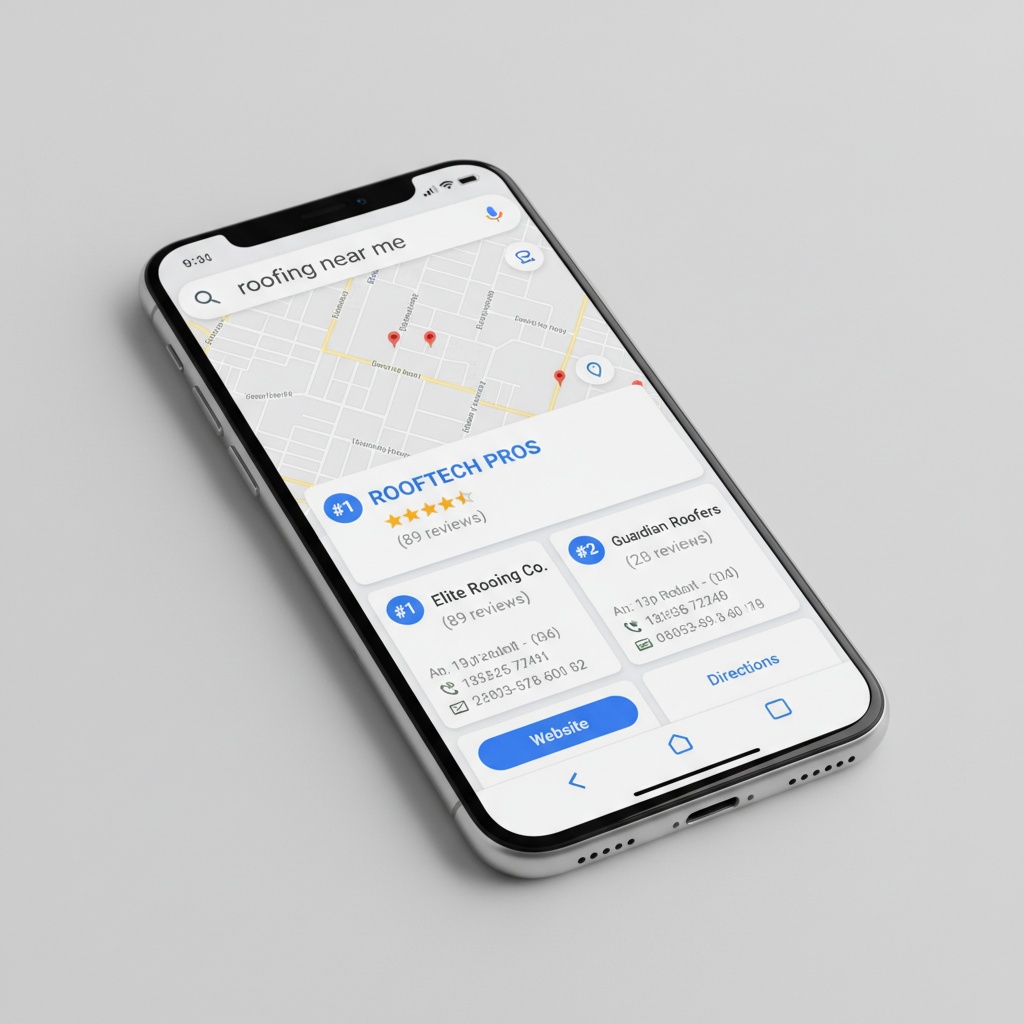
Here's what happens when it works: a homeowner's roof starts leaking at 2 p.m. on a Tuesday. They pull out their phone. They type 'roofer near me.' Google shows them 3 businesses on a map. Your name is the first one they see. They tap your number. You answer (or they text you immediately). Job booked. That's local SEO for contractors.
Without it, someone else answers that call. Every single day.
The three pillars Google uses to rank contractors locally
Google ranks local businesses on three things: Proximity, Relevance, and Prominence. Proximity means how close you are to the search location. Relevance means your Google Business Profile and website actually match what the customer searched for. Prominence means how many reviews, citations, and signals Google sees that you're legit and trusted.
You can't move your shop to be closer to every customer. But you can own Relevance and Prominence. That's where 70% of contractors get it wrong.
- Proximity: Your business address and service area radius on Google Business Profile.
- Relevance: Keywords in your business name, description, service list, and website content that match what people search for in your trade.
- Prominence: Review count, review rating, review recency, local citations (Yelp, BBB, HomeAdvisor), and backlinks to your website.
Ranking is also different on every street corner. You don't have one Google Maps rank. You have a geo-grid. Your rank shifts based on the searcher's exact location.
Google Business Profile optimization: the foundation
Your Google Business Profile is the single most important asset for local SEO. It's the thing that shows up on the right side of Google Search and on Google Maps. If it's incomplete, wrong, or ignored, you lose 3.5x more calls than you could win.
Here's what contractors need to do:
- Claim and verify your listing if you haven't already. Go to google.com/business and search your name.
- Fill every field completely: business name, address, phone, website, business category, description, hours, photos of your work, service areas (set the radius correctly for where you actually work).
- Post regularly. Google gives recent activity a boost. One post per week minimum.
- Get reviews. 46 reviews is the median number for a top-ranked contractor in a mid-sized market. Most contractors have 3 to 8.
- Respond to all reviews within 24 hours, good or bad.
Contractors who optimize Google Business Profile see 3.5x more calls in the first 90 days. It's not a side project. It's the job.
Building a mobile-first website that converts callers
Your website has to load in under 2 seconds on mobile. The industry average is 6 to 8 seconds. Slow sites don't rank and visitors bounce before your phone number is even visible.
Here's what works for contractors: homepage that shows your photo, your service list, your city/zip code, and a clickable phone number above the fold. A gallery of your work. Testimonials and review count. One clear call to action. That's it. No fluff. No auto-playing videos.
Your website also needs to be on the same domain for at least 6 to 12 months before Google trusts it for local ranking. A new domain takes longer to build prominence.
The website also has to serve your local SEO strategy. Every page should target a specific service and location combination. 'Roof repair in Denver' is different from 'roof repair in Boulder.' Google knows the difference.
The map pack: where most contractors lose jobs
The map pack is the three business results that show on Google Search when someone searches a local term. It's usually the first thing they see after ads. If you're not in it, you don't exist to that customer.
88% of local mobile searches end in the top 3 results. Anything outside those 3 is invisible. And the map pack rotates based on the searcher's exact location, so you need to own your geo-grid across your entire service area, not just one spot.
To get into the map pack, you need: (1) a Google Business Profile that matches the search intent, (2) an optimized website with location-specific content, (3) reviews and citations that prove prominence in that area, (4) business listed on local directories like BBB, Yelp, and HomeAdvisor with consistent name, address, phone.
Most contractors skip steps 3 and 4. They wonder why they're not showing up.
Reviews: the fuel that keeps you ranking
Reviews are the single fastest way to climb local SEO rankings. Google sees review count, rating, and recency. A business with 50 recent 5-star reviews beats a business with 8 reviews and a 4.8 rating, every time.
The problem: 67% of people who should have left you a review didn't. They called you, you did great work, they paid, and then you never asked. Missed opportunity.
Here's the math: with an automated 5-star review engine, contractors see roughly 47 new reviews per year. That's 4 per month without you chasing customers. Over 2 to 3 years, that's a difference of 100+ reviews. That's the gap between ranked and invisible.
The system works: ask within 24 hours of job completion, ideally via text (where open rates are 98%), with a one-click link to Google Reviews.
When local SEO for contractors is NOT worth it right now
Local SEO takes 90 to 180 days to work. If you need leads next week, this isn't the answer. You need Google Ads or emergency phone support from a local marketing firm.
If you only work in a rural area with very low search volume, local SEO will drive fewer calls than a service area with 100,000 people and high competition. You'll still rank, but there may not be many people searching.
If you're a one-man operation with 3 months of booked work already, you don't have capacity. Fix your operations first, then invest in local SEO to scale.
If you've been burned by an agency before and you're not willing to check your Google Business Profile for 30 days straight, you'll sabotage the whole thing by ignoring feedback. Local SEO requires attention, not monthly retainers to a ghost team.
How to get started: the 30-day quick wins
You don't need to be perfect. You need to be consistent and better than 80% of your competitors, who aren't doing this at all.
Week 1: Claim and verify your Google Business Profile. Fill every field. Upload 10 photos of your actual work.
Week 2: Make sure your website loads fast on mobile (use Google PageSpeed Insights). Add your service list and service areas to every page.
Week 3: Ask your last 10 customers for Google Reviews. Use a text message. Make it one click.
Week 4: Post on your Google Business Profile twice. Add your business to Google Maps, Yelp, BBB, and your industry directory (HomeAdvisor, Angie's List, etc.).
After 30 days, you'll see call volume from your local SEO efforts start to move. Real movement happens in 90 to 180 days. Most contractors quit at 60 days because they're not patient.
If this sounds like too much, or you need it done right and live in 7 to 10 days, JR Grow is a done-for-you system that handles all four: the website, missed-call text-back, local SEO + Google Business Profile optimization, and the automated review engine. One dashboard. One flat price. No contract.
Key terms
Google Business Profile: The free business listing on Google that shows your name, address, phone, hours, reviews, and photos when someone searches your trade locally or on Google Maps.
Map pack: The three local business results displayed on Google Search, usually with a map on the right side, when someone searches a local query like 'plumber near me'.
Geo-grid: The fact that your Google ranking is different on every street corner based on the searcher's location; you don't have one rank, you have dozens across your service area.
Local citation: Your business name, address, and phone listed on a third-party directory like BBB, Yelp, HomeAdvisor, or Angie's List, which Google uses to verify your prominence and legitimacy.
Service area radius: The distance you set on your Google Business Profile to tell Google how far from your address you'll travel to serve customers, which affects your visibility in that geographic range.
Straight from Google, worth reading in full: Tips to improve your local ranking on Google and Guidelines for representing your business on Google.
Want your phone ringing again?
JR Grow builds your website, ranks you on Google, recovers missed calls, and fills your Google profile with 5-star reviews. Done for you. One flat price. Cancel anytime. Live in 7-10 days.
Book a Free Strategy Call →Frequently asked questions
How long does local SEO take to work for a contractor?
90 to 180 days is typical before you see real call volume. Your Google Business Profile can get traction faster if it's completely filled out and has recent reviews. Patience is the hardest part. Most contractors quit at 60 days.
Do I need a website to rank in Google Maps?
Technically no, you can show up in Google Maps with just a Google Business Profile. But a website makes you 3x more likely to convert a call into a booked job, and it helps Google understand your relevance better. A fast mobile website is essential.
Why am I not showing up on Google Maps even though I have a Google Business Profile?
Your profile is incomplete, not verified, or it's incomplete. Your location settings are wrong. You have no reviews or very few reviews. Your website is slow or doesn't mention your location and services. Your competitors have more reviews and better prominence signals. Check all four.
How many reviews do I need to rank in the map pack?
There's no magic number, but 20 to 30 reviews is usually enough to compete in a small to mid-sized market. In a competitive market, you may need 50+. Review recency matters more than count. One new review this week beats 10 old reviews from a year ago.
Can I do local SEO myself or do I need to hire someone?
You can do the basics yourself: fill out Google Business Profile, get reviews, build a fast website, post regularly. It takes 5 to 10 hours a month. Most contractors don't have that bandwidth and would rather focus on the trade. A done-for-you service or in-house person is usually better ROI.