How to rank in the Google Map Pack: Local 3-pack for contractors
How to rank in the Google Map Pack means getting your business into the top 3 local results when a homeowner searches for your trade on Google. This is where 88% of local searches end. You're either in the 3-pack or invisible.
Updated August 2026 · By JR Grow
What is the Google Map Pack and why it matters for your jobs
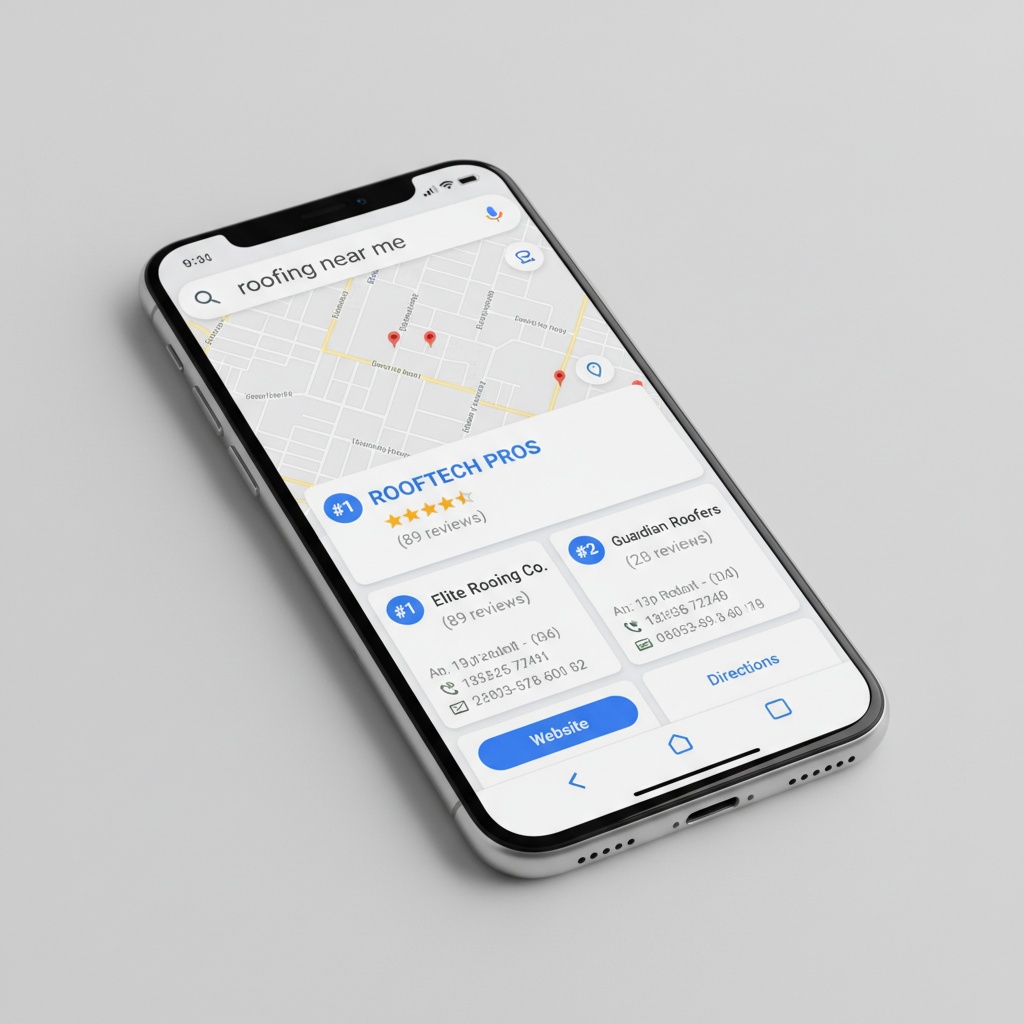
The Google Map Pack, also called the local 3-pack, is the map and business listing area that shows up at the top of Google search results for local queries. When someone searches "roofer near me" or "emergency plumber in Denver," the 3-pack appears before the regular website results. This is prime real estate.
88% of local mobile searches end in the top 3 results. If you're not in that 3-pack, you're not getting the call. Your competitor is. How to rank in the Google Map Pack is not about hoping. It's about following Google's three ranking signals: Proximity, Relevance, and Prominence. Master these three, and the jobs follow.
A typical contractor sees roughly 3.5x more calls after 90 days of serious Google Business Profile optimization. That's not a coincidence. That's the system working.
Proximity: Distance matters, but it's more complicated than you think
Proximity sounds simple: Google shows businesses closest to the searcher. Wrong. It's more nuanced. Google ranks businesses on a geo-grid. The exact street corner where someone searches changes the ranking order. A business that ranks #1 on Fifth and Main might rank #2 on Fifth and Seventh, three blocks away.
This is why contractors who service a wide area see inconsistent results. You can't rank everywhere equally. You optimize for your core service areas and let proximity do its job for the rest.
Action: Verify your Google Business Profile address is accurate and matches your real location. If you service multiple areas, create service area entries (not fake office locations). Google knows when you're faking it.
Relevance: Your Google Business Profile must match what people are searching for
Relevance is about signal alignment. If someone searches "roof repair" and your Google Business Profile says "roofing contractor" with no mention of repair, Google gives you a weaker relevance score than a competitor whose profile screams "roof repair." The words matter.
Your Google Business Profile categories, business description, and service offerings must match the exact language homeowners use. Not your language. Theirs. "HVAC maintenance" is more relevant to "AC repair near me" than "climate control optimization systems."
Update your profile description to include the top 5 services you actually do. Use the categories Google provides, and add every relevant service in the "Services" section of your profile. This tightens the relevance signal.
- Primary category: Choose the one that defines your core business
- Secondary categories: Add 2-3 related categories (roofer can add "gutter service")
- Service list: Add every service you offer, in plain language
- Description: Write 750+ characters. Use local keywords naturally
Prominence: Build authority so Google trusts you enough to rank you
Prominence is how much "authority" Google thinks your business has. It's built on three pillars: Google Business Profile optimization, online reviews (especially Google reviews), and backlinks (other websites linking to yours).
Google Business Profile optimization means completeness. Every field filled out. High-quality photos. Regular posts. Updated hours and services. An incomplete profile signals weakness to Google. A complete one signals a real, active business.
Reviews are the second pillar. Google's algorithm rewards businesses with more reviews and higher ratings. An automated 5-star review engine can generate roughly 47 reviews per year across a typical contractor practice. That consistent flow of fresh reviews tells Google your business is trustworthy and active. Don't ignore this. Your competitors aren't.
The third pillar is backlinks: mentions of your business on other websites (local directories, industry sites, local news). These are harder for a small contractor to build solo, but they amplify your prominence score. Most contractors benefit from a done-for-you system that builds this quietly over time.
Map pack ranking in 90 days: The real timeline
Contractors ask, "How long until I rank?" Honest answer: 30 to 90 days for most niches if you execute properly. Some highly competitive markets take longer. Some take less time.
Google Business Profile changes take effect within 1-2 weeks. Review signals accumulate over months. The Google Map Pack is dynamic. As you add reviews, fill out your profile, and build prominence, your position climbs.
Week 1-2: Claim and optimize your profile (all three ranking signals start here). Week 3-8: Reviews and signals compound. Week 9-12: Most contractors see solid movement toward the 3-pack. This assumes consistent effort. Abandoned profiles stay buried.
A done-for-you approach (like JR Grow) automates this: profile optimization on day one, missed-call text-back recovers callers you'd otherwise lose (67% of callers won't leave a voicemail), and an automated review engine keeps the prominence signal firing every month. The compounding effect is real.
How to rank in the Google Map Pack: The checklist
Here's the step-by-step. Do this and you've solved 80% of the problem.
- Claim your Google Business Profile (if you haven't already). Verify it with Google.
- Fill out every field: business name, address, phone, website, hours, categories, description.
- Add 2-5 high-quality photos of your work, team, and storefront (if you have one).
- Choose the right primary category (roofer = "Roofing Contractor," not "Contractor" generic).
- Write a 750+ character description. Use local keywords naturally ("Roof repair and installation in Denver and surrounding areas").
- Add all services you offer in the Services section.
- Create a process to collect Google reviews consistently (ideally 1-2 per week). Respond to every review within 48 hours.
- Post to Google Business Profile every 2-4 weeks (updates, special offers, project photos).
- Verify your website loads fast (under 2 seconds) and is mobile-first (90% of contractors' searches are mobile).
- Monitor your Google Business Profile insights monthly. Track which searches show your business and what areas drive clicks.
When DIY doesn't work: When to hire for map pack ranking
Honest truth: Most contractors can optimize their Google Business Profile themselves in a few hours. It's not hard. Claiming, filling out fields, adding photos, writing a description. You can do this.
Where it breaks down: Consistency. Reviews don't come by themselves. Missed calls don't turn into texts on their own. Your website might load slow. Your local keyword strategy might miss the mark. The small details compound over months, and most contractors get tired and let it slide.
A done-for-you system like JR Grow handles this: profile optimization on day one, a fast mobile-first website that turns visitors into booked jobs, missed-call text-back (auto SMS within 30 seconds recovers up to 80% of lost jobs), local SEO optimization, and an automated review engine, all on one dashboard. One flat monthly price, no contract, live in 7-10 days. It's built for contractors who are great at the trade but don't have time to become SEO experts. 100+ contractors average 4.9 stars.
DIY works if you commit to consistency. Hiring works if you want the system running without you managing it weekly. Either way, the three ranking signals (Proximity, Relevance, Prominence) are non-negotiable. Pick your path and execute.
Common mistakes that tank your map pack ranking
These cost contractors jobs every month. Don't do them.
- Incomplete or outdated Google Business Profile. An old address, missing phone number, or empty description tells Google your business is inactive.
- Inconsistent business name. "John's Plumbing" vs. "Johns Plumbing" vs. "John Plumbing" confuses Google. Pick one and use it everywhere.
- Wrong category. Picking "Contractor" instead of "Roofing Contractor" makes you less relevant to roofing searches.
- No review strategy. Competitors with reviews outrank those without. Period.
- Fake office locations. Some contractors create fake addresses to appear in multiple markets. Google penalizes this. Don't do it.
- Ignoring mobile. Your website loads in 6-8 seconds? You're invisible. Fast mobile sites rank higher and convert better. Under 2 seconds is the target.
- Slow response to reviews. Respond within 48 hours. Ignore reviews and Google sees a business that doesn't care.
Track your progress: Metrics that actually matter
Don't just hope you're ranking. Track it.
Google Business Profile Insights shows you everything: which search queries brought people to your profile, how many calls, how many website visits, how many direction requests. This data is free and gold. Check it monthly. Are searches for "emergency plumber" finding you? Great. Are searches for "water heater repair" showing your competitor instead? That's a relevance and prominence gap you can fix.
Track your position over time. You don't need fancy tools. Google your main keywords locally (search "plumber near me" on a mobile phone in your service area) and note where you appear. Repeat monthly. If you're climbing from position 8 to 5 to 3 over 90 days, the system is working.
Track review growth. An automated engine should generate 3-5 reviews per month. Measure it. If you're getting 1 review per year, your prominence signal is weak. Fix it.
Track phone calls and web traffic. A typical contractor sees 3.5x more calls after 90 days of serious optimization. If calls aren't climbing, something is broken.
Key terms
Google Map Pack: The map and business listing area that appears at the top of local Google search results, showing up to 3 businesses with their location, ratings, and key details.
Local 3-pack: Another name for the Google Map Pack, referring to the 3 businesses that rank highest in local search results on Google.
Google Business Profile: The free Google business listing that displays your name, address, phone, hours, reviews, photos, and services in Google Search and Google Maps.
Geo-grid: Google's system of dividing a service area into small geographic zones, where rankings can vary block-by-block based on the exact location of the search.
Prominence: Google's measure of how well-known and trusted your business is, based on reviews, profile completeness, website quality, and backlinks.
Straight from Google, worth reading in full: Tips to improve your local ranking on Google and Guidelines for representing your business on Google.
Want your phone ringing again?
JR Grow builds your website, ranks you on Google, recovers missed calls, and fills your Google profile with 5-star reviews. Done for you. One flat price. Cancel anytime. Live in 7-10 days.
Book a Free Strategy Call →Frequently asked questions
How long does it take to rank in the Google Map Pack?
30 to 90 days if you execute the three signals properly (Proximity, Relevance, Prominence). Some competitive markets take longer. Google Business Profile changes take effect within 1-2 weeks. Reviews and authority build over months. Consistency matters more than speed.
Do I need a website to rank in the local 3-pack?
No. You can rank in the Google Map Pack with just a Google Business Profile. But a website helps. A fast, mobile-first website converts visitors into booked jobs better than a profile alone. Google also considers website quality and load speed as part of your prominence signal, so having one (and making it fast) helps.
Can I rank in multiple locations if I'm a solo contractor?
Yes, but not equally. Proximity changes ranking on every street corner. You can optimize for your core service area and let proximity work for areas you service. Don't create fake office locations. Google knows and penalizes it. Use service area entries instead.
How many Google reviews do I need to rank in the 3-pack?
There's no magic number. More reviews and higher ratings help your prominence signal. A business with 50 reviews at 4.8 stars ranks higher than one with 5 reviews at 5 stars. An automated review engine typically generates 3-5 reviews per month, which keeps your signal fresh and competitive.
What if I'm in a super competitive market (big city, lots of roofers)?
Competitive markets take longer and require sharper execution. Focus on niche relevance (roof repair vs. general roofing), build reviews faster, and ensure your website is fast and mobile-first. A done-for-you system can accelerate this because the work runs without you managing it weekly.