
AI receptionist vs answering service for contractors, compared
AI receptionist vs answering service both answer phones, but they work very differently. An AI receptionist handles calls instantly with no human middleman. An answering service routes to a live person on staff. For contractors, the choice comes down to whether you want speed or a human voice on missed calls.
Updated August 2026 · By JR Grow
AI receptionist vs answering service: the core difference
An AI receptionist is software that answers your phone, qualifies the caller, books appointments, and sends you a text or summary in seconds. No waiting. No operator saying your name wrong. It never sleeps, never gets irritable, never calls in sick.
An answering service is a company that employs live receptionists. They answer your phone and either transfer the call to you or take a message. They work business hours (usually 9-5), charge per call or per month, and you have no direct control over how the call is handled. Quality depends on whoever picks up that day.
For AI receptionist vs answering service in the trades, the practical difference is this: AI is instant and automated. An answering service is human but slower and more expensive per call handled.
Cost: AI receptionist wins on price
A typical answering service charges $1.50 to $3.00 per call, or a flat $800 to $2,000 a month. That adds up fast if you get 30 calls a month. A $1,500 answering service bill divided by 30 calls is $50 per call.
An AI receptionist usually runs $200 to $600 a month flat, or per-call pricing as low as $0.50 per handled call. No setup fee, no long contract. The math is tight: 30 missed calls a month, the AI option pays for itself immediately.
Real example: a plumber averaging 40 missed calls a month on a $1,200 answering service bill is paying $30 per recovered call. Swap to an AI receptionist at $400 a month and suddenly that's $10 per call. The difference is $3,200 a year.
Response time: AI is instant, answering service is minutes
67% of callers won't leave a voicemail. They call the next contractor. Every second matters.
An AI receptionist picks up in the first ring, qualifies the caller (name, address, job type), and books an appointment or texts you a lead summary within 30 seconds. No hold music. No waiting. The caller either hears a human prompt or a natural voice AI.
An answering service transfer can take 30 seconds to 2 minutes. The receptionist has to look up your schedule, find your number, try to reach you, and keep the customer on hold. If you don't answer, they leave a voicemail or take a message. Now the contractor has to call back and chase a potentially cold lead.
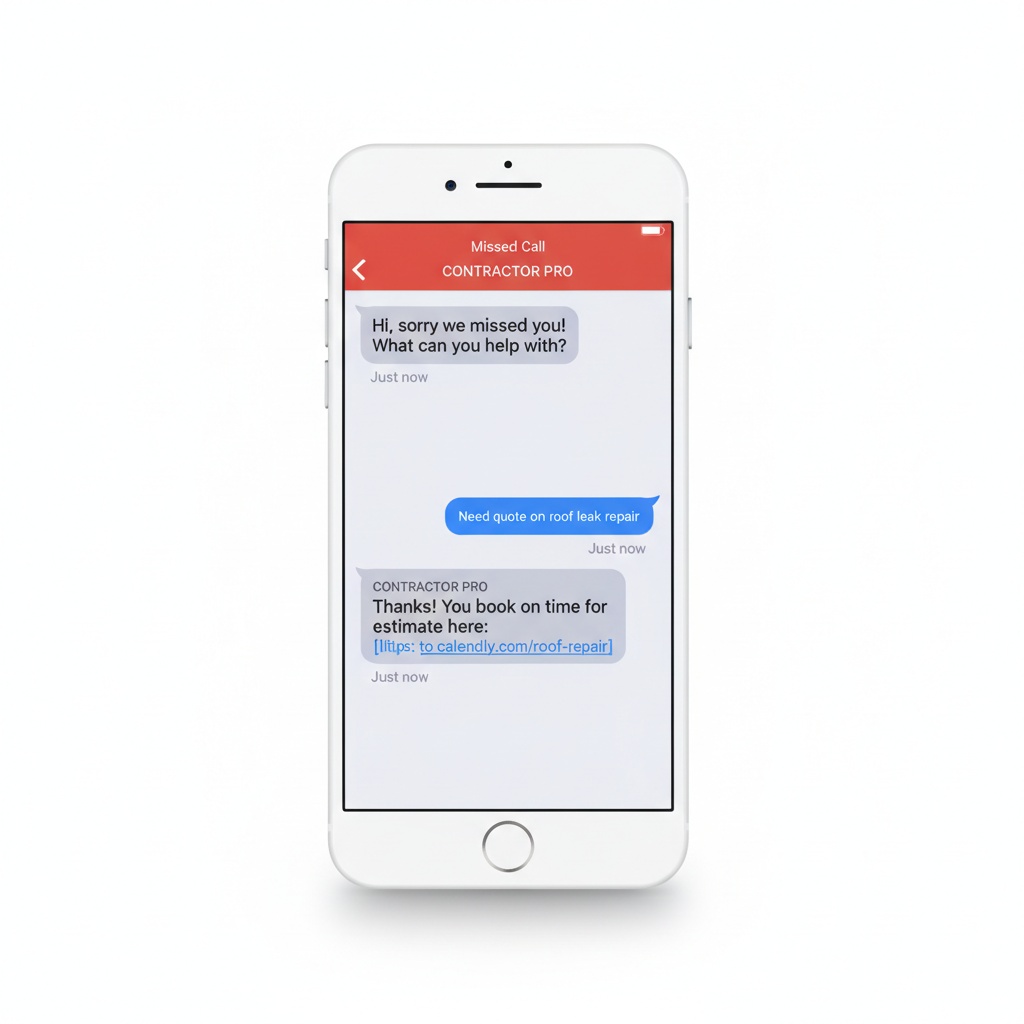
For missed-call text-back specifically: an AI receptionist sends an SMS in 30 seconds. An answering service either doesn't offer it or charges extra. Missed-call text-back recovers up to 80% of lost jobs because the customer gets instant confirmation, even if you're not available yet.
Call quality and handling
An AI receptionist follows a script you set. It asks for the job address, damage description, urgency level, and the caller's name and number. No small talk. No mistakes. Consistency every single time.
An answering service depends entirely on who answers. One day you get a pro. Next day you get someone who didn't write down the address or said your company name wrong. Turnover is high in that industry. You often can't control the tone or the questions being asked.
However, some customers prefer a human voice on the phone. If your brand relies on that personal touch, an answering service might feel better at the moment of the call, even if it costs 3x more and response time is slower.
A virtual receptionist (which can be AI or a hybrid of AI plus human backup) splits the difference. It handles the initial qualification automatically, and escalates complex calls to a human only when needed.
Integration with your business tools
An AI receptionist typically plugs into your calendar, CRM, text messaging, and email in one dashboard. JR Grow, for example, integrates the AI receptionist with automated review requests, Google Business Profile sync, and missed-call SMS all in one place. You see every interaction in real time.
An answering service is a separate vendor. They call you, email you, or use a portal. You have to copy information into your own system. More steps. More room for error. Another bill to pay, another contract to cancel.
If you're already using a CRM (HubSpot, Pipedrive, etc.) or job management software (ServiceTitan, Housecall Pro), an AI receptionist that integrates saves you hours a week re-entering data.
When an answering service might still make sense
An answering service is worth considering if: you need someone to take notes on complex jobs (architectural consultations, large commercial bids), you want a local voice answering your phone during business hours, or you're in a niche market where customers expect a receptionist.
You should skip both AI receptionist and answering service if you're getting fewer than 5 missed calls a month. The overhead doesn't justify it. Just make sure you answer your phone yourself or have a team member on call.
AI receptionist vs answering service also depends on your tolerance for automation. Some contractors hate the thought of a bot on their line. If that's you, an answering service feels more comfortable, even if it's slower and costs 3x more.
Speed and recovery: why contractors pick AI
88% of local mobile searches end in the top 3 results. Off the first page, you're invisible. The same principle applies to response time: the contractor who texts back in 30 seconds wins the job more often than the one who calls back in 30 minutes.
Missed-call text-back is the enforcement mechanism. A customer can't remember which roofer they called if you never reach back. But a text with your name, address, and next steps keeps the job in their hand. An AI receptionist sends that text automatically. An answering service usually doesn't, or charges extra.
In 90 days of using an AI receptionist with text-back, contractors typically see about 3.5x more inbound calls (the calls you do catch). Why? Because the callers who got a fast response tell their friends. Word spreads.
The virtual receptionist option: hybrid approach
A virtual receptionist sits between pure AI and a full answering service. It's usually AI-first (instant pickup, call qualification), but with a human available for escalation or complex calls.
This hybrid model is especially useful if you get seasonal volume spikes or if certain call types need human judgment. The AI handles the volume. The human handles the edge cases.
Cost is typically $400 to $800 a month, lower than a traditional answering service but higher than pure AI. Response time is still instant (AI picks up first). You get the best of both.
Bottom line: AI receptionist vs answering service for your trade
Choose AI receptionist if you want speed, lower cost, automation, and real-time data in your phone. 67% of callers won't leave a voicemail. An AI answers before they hang up. Missed calls become booked jobs, not lost leads.
Choose an answering service if you need a human voice during specific hours, you're in a niche market, or you have 10+ calls a day and staff bandwidth isn't your bottleneck.
Choose nothing if you're getting fewer than 5 missed calls a month and you can answer your own phone.
Many contractors use both: AI receptionist for nights and weekends, answering service for peak hours if they're swamped. But if you're choosing one, AI wins on ROI, speed, and integration with the rest of your business.
JR Grow bundles AI receptionist with missed-call text-back, automated reviews, local SEO, and a fast mobile website on one dashboard. 100+ contractors, 4.9-star average. No contract. Live in 7-10 days. The entire system runs while you work.
Key terms
Missed-call text-back: An automated SMS sent to a caller within 30 seconds if you miss their call, confirming their request and your availability. Recovers up to 80% of lost jobs.
Call qualification: A set of questions asked during or after a call to gather the customer's name, address, job type, and urgency. Helps prioritize which leads matter most.
Virtual receptionist: A hybrid service that starts with AI (instant pickup and qualification) but escalates complex calls to a human operator. Faster than a traditional answering service, cheaper than a full-time receptionist.
Voicemail abandonment: When a caller hangs up rather than leave a voicemail. 67% of callers won't leave one, meaning 67% of missed calls are lost jobs unless you have call recovery in place.
Straight from Google, worth reading in full: Tips to improve your local ranking on Google and Guidelines for representing your business on Google.
Want your phone ringing again?
JR Grow builds your website, ranks you on Google, recovers missed calls, and fills your Google profile with 5-star reviews. Done for you. One flat price. Cancel anytime. Live in 7-10 days.
Book a Free Strategy Call →Frequently asked questions
Do I really need either one?
If you're missing calls and losing jobs to your competitors, yes. 67% of callers won't leave a voicemail. They call the next contractor. An AI receptionist or answering service recovers those calls. If you're answering every call yourself or you get fewer than 5 missed calls a month, you don't need either one.
Which one books more jobs?
AI receptionist typically books more because it answers in the first ring, qualifies the caller, and sends missed-call text-back in 30 seconds. An answering service is slower and often doesn't offer text-back. Missed-call text-back recovers up to 80% of lost jobs. Speed wins.
Can I use both at the same time?
Yes. Some contractors use an AI receptionist for nights and weekends, and an answering service during peak business hours if they need extra human capacity. It costs more but handles unpredictable volume. Most start with AI only and scale up if they hit volume limits.
Will my customers think they're talking to a robot?
Modern AI receptionists sound natural and conversational. Most callers don't know they're talking to AI until you tell them. An answering service sounds like an answering service (hold music, transfers, delays). Both are credible. AI is faster.
What if I'm already paying an answering service?
Compare your monthly bill to the cost of an AI receptionist plus text-back. If your bill is $1,000+ a month and you're getting fewer than 30 qualified leads a month, you're likely paying $30+ per recovered call. An AI receptionist at $400 a month cuts that to $13 per call. The ROI is immediate.